【题目】As early as the mid-18th century, some people began raising doubts about Marco Polo’s travels. In 1995, historian Frances Wood argued in her book Did Marco Polo Go to China? that the famous explorer from Venice never made it to pass the Black Sea. She noted that his travel journal left out the Great Wall of China, chopsticks and tea drinking among other details. Furthermore, Chinese documents from Polo’s day made no mention of the explorer and his men.
Wood and other scholars have argued that Marco Polo based his tales of China on information collected from fellow trades who had actually been there. Last year, a team of Italian researchers became the latest to challenge Polo’s accounts(叙述). They said that evidence didn’t support his description of Kublai Khan’s Japanese invasions (侵略).
Now, however, research by Hans Ulrich Vogel of Germany’s Tubingen University might help prove Marco Polo was true. In a new book Marco Polo Was in China,the professor of Chinese history tries to prove that Marco Polo spoke the truth. He suggests, for example, that Polo didn’t include the Great Wall in his book because it only achieved its great importance in the Ming Dynasty several hundred years later. Vogel further explains that Chinese records from the 13th and 14th centuries avoided setting down visits from Westerners.
Historians before him have touched on these issues. But Vogel also relies on another evidence:the explorer’s very detailed descriptions of currency and salt production in the Yuan Dynasty. According to Vogel, Polo documented these aspects of Mongol Chinese culture in greater detail than any other of his time. This is a hint (暗示) that Polo relied on his own powers of observation.
Will we ever know whether Marco Polo traveled to China? Perhaps not, but the consequences of his real or fictional journey are still felt across the globe. One reader of The Travels of Marco Polo was Christopher Columbus, who stepped upon the New World while following his idol’s footsteps.
【1】France Wood doubted Marco Polo’s travel’s to China because his description ________.
A. missed some important culture of China
B. covered so much about traders’ life
C. was full of obvious mistakes
D. seemed less detailed
【2】Vogel’s trust on Marco Polo is based on the argument that ________.
a. The Great Wall didn’t gain its importance then
b. Records in the Yuan Dynasty mentioned Polo
c. Polo mentioned the currency and salt
d. Polo’s other works are believable
e. Polo recorded what he saw in great detail
A. a, b, dB. a, c, dC. a, e D. b, c
【3】Which of the following shows the structure of the text?(P1为第一段,以此类推)
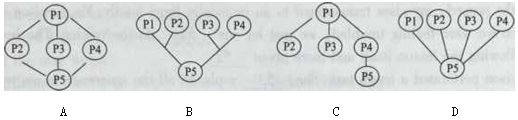
【答案】
【1】A
【2】C
【3】B
【解析】
试题分析: 本文对马可波罗是否来过中国进行了探究。有人认为马可波罗没来过中国,因为他遗漏了中国很多重要的文化标志;有人则相信马可波罗来过中国,因为他对细节描述的如此详细。但不管他有没有来过中国,他的游记的影响在全世界都可以感觉得到,比如哥伦布就是看了他的游记踏上寻找新世界的旅程的。
【1】A 细节理解题。根据文中第一段中的She noted that his travel journal left out the Great Wall of China, chopsticks and tea drinking among other details. Furthermore, Chinese documents from Polo’s day made no mention of the explorer and his men.可知,France Wood之所以怀疑马可波罗是否到过中国旅行是因为她注意到他的游记遗漏了长城,筷子和饮茶,以及其他细节;此外,中国的文件中也没有提到这位探险家和他的人。故选A。
【2】C 细节理解题。根据文中第三段后半部分Polo didn’t included the Great Wall in his book because it only achieved its great importance under the Ming Dynasty, several hundred years later. Vogel further explains that Chinese records from the 13th and 14th centuries routinely avoided setting down visits from Westerners.可知,Vogel之所以相信马可波罗是因为长城在几百年之后,也就是明代才有了它的重要性。而且他进一步认为,中国的记录,从第十三和第十四世纪经常掩盖西方使节访问。故选C。